Watch the following videos to help you understand the different types of nuclear reactions that can occur and the nuclear equations we can write down to describe them.
Showing posts with label Honors Chemistry. Show all posts
Showing posts with label Honors Chemistry. Show all posts
Thursday, December 12, 2013

Flame Test Lab
Watch the following video to see what we did in class when we performed the Flame Test Lab. Follow along and fill in the data table on your lab paper, including the answers for the two "unknown" chemicals. When this is done, please answer the lab questions that go along with the experiment, based on what you see in lab/the video and what we have learned in class about excited electrons and light.
Monday, December 9, 2013
Bonding #4 -- Bond Polarity
Watch the following video for a good overview of Electronegativity and Bond Polarity -- the difference between Ionic Bonds, Polar Covalent Bonds, and Non-Polar Covalent Bonds. (total time = 9 minutes)
Bonding #3 -- Covalent Bonding, Lewis Structures, VSEPR
Watch the following two videos for a good overview of Covalent Bonding, Lewis Diagrams, and the VSEPR model to explain molecular shapes.
Bonding #2 -- Metallic Bonding
Watch the following two videos for a good overview of Metallic Bonding and the properties of substances held together by metallic bonds, called Metals or Metallic Solids. (total time = 10 minutes)
Bonding #1 -- Ionic Bonding
Watch the following two videos for a good overview of Ionic Bonding and the properties of substances held together by ionic bonds, called Ionic Solids. (total time = 10 minutes)
Tuesday, November 19, 2013
Periodic Table Properties and Trends
Elements have different properties based on the valence electrons in their atoms. These valence electrons and properties control how the atoms of that element will react with other elements.
Because the number and position of valence electrons an atom has matches up with its location on the Periodic Table, elements with similar valence electrons will have similar properties and are found in the same groups (up and down columns) on the Periodic Table. In addition, as you go across each row from left to right and down each column on the Table, the elements show patterns in their properties and behaviors based on where they are located in the Table.
Several important properties of atoms we need to know about are:


http://www.mhhe.com/physsci/chemistry/essentialchemistry/flash/atomic4.swf

Because the number and position of valence electrons an atom has matches up with its location on the Periodic Table, elements with similar valence electrons will have similar properties and are found in the same groups (up and down columns) on the Periodic Table. In addition, as you go across each row from left to right and down each column on the Table, the elements show patterns in their properties and behaviors based on where they are located in the Table.
Several important properties of atoms we need to know about are:
- Atomic Size (Radius)
- Ionic Size (Radius)
- Ionization Energy
- Electronegativity
- Atomic Size (Radius) shown as a line graph.
- Atomic Size (Radius) shown as a bar graph in the Periodic Table.
- Click on this link to go to a Flash animation explaining about atomic properties, how they are related to electrons, and the patterns they show in the Periodic Table.
http://www.mhhe.com/physsci/chemistry/essentialchemistry/flash/atomic4.swf
- All of the properties and their patterns on the Periodic Table.
Tuesday, November 5, 2013
Electrons #5: Electrons in Atoms and Periodicity
Electron Configurations use quantum numbers (probability descriptions of where an electron is located outside of its nucleus) to differentiate among and list out all of the electrons in an atom.
http://www.sciencegeek.net/Chemistry/taters/Unit2ElectronNotations.htm
http://www.sciencegeek.net/Chemistry/taters/Unit3ValenceElectrons.htm
- Watch this short video and then go to each of the website links that follow. Pay extra attention to the discussion of Coulomb's Law and shielding.
- Answer the questions on each of the links.
http://www.sciencegeek.net/Chemistry/taters/Unit2ElectronNotations.htm
http://www.sciencegeek.net/Chemistry/taters/Unit3ValenceElectrons.htm
Sunday, November 3, 2013
Electrons #4: Electronic Orbitals, Part II
Watch the following videos to learn about and help you understand the electronic structure of atoms. (Total time 30 minutes)
- 1st video goes into more detail about what the quantum numbers we use to describe where electrons are in each atom actually mean.
- 2nd video continues to discuss quantum numbers and uses more pictures of orbitals to help you understand how we have to talk about the electrons in an atom.
Saturday, November 2, 2013
Electrons #3: Electronic Orbitals, Part I
Watch the following video to learn about and help you understand the electronic structure of atoms.
http://www.chemguide.co.uk/atoms/properties/atomorbs.html

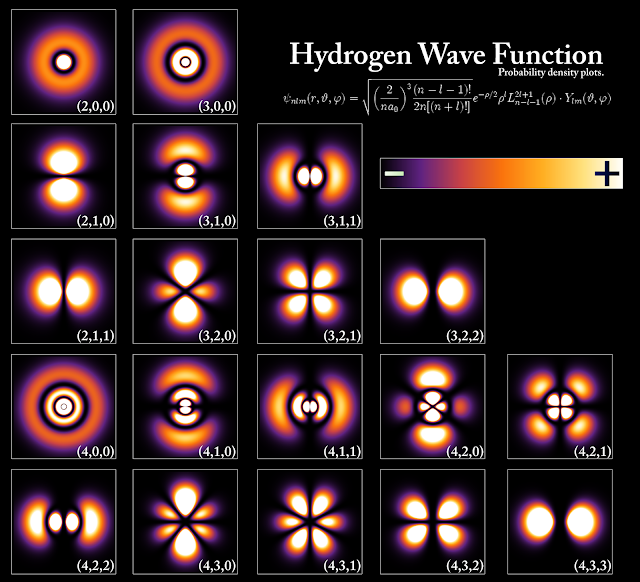
- 1st video has a good overview of the whole process.
- 2nd video explains the techniques and vocabulary chemists use to talk about electrons and their strange behavior as they move around the nucleus.
- Click on the following link to read about electron orbitals and electron configurations.
http://www.chemguide.co.uk/atoms/properties/atomorbs.html
- Look at the following two pictures. The first is a simplified color-coded representation of the s, p, d, and f sublevels and the 1, 3, 5, and 7 orientations (orbtials) that each one has respectively. The second picture shows some of the same orbitals as they really are, probability density plots of the electron's wave function.
Friday, November 1, 2013
Electrons #2: Electrons and Light
Click on this link and follow along with the Flash animation to help you understand how the quantum nature of electrons was discovered by looking at the colors of light produced when elements are heated. The animation also connects the colors of light produced to the location and behavior of electrons in an atom, relative to their nucleus.
http://www.mhhe.com/physsci/chemistry/essentialchemistry/flash/linesp16.swf
http://www.mhhe.com/physsci/chemistry/essentialchemistry/flash/linesp16.swf
Thursday, October 31, 2013
Electrons #1: Quantum Nature of Electrons
After watching the NOVA special in class, watch the following videos (the first video links to a playlist of 8 short videos, totaling 40 minutes) to help you understand quantum physics and how it applies to electrons.
Wednesday, October 30, 2013
Half-Life and Radioactive Decay Activities
Look at the following graph and run the three applets on this page to explore and learn more about radioactive decay and half-life.
 |
| Half-Life: Radioactive Decay and Exponential Curve |
The first applet shows alpha decay.

The second applet shows beta decay.
The second applet shows beta decay
The
| Click to Run |

| Click to Run |
The third applet shows half-life curves and how to use them to find the age of things buried in the ground.

| Click to Run |
Radioactive Decay and Half-Life Overview
Watch the following video to learn more about radioactive decay and how long it takes atoms to decay, known as half-life.
Watch the following video to help you understand how to do half-life calculations.
Watch the following video to help you understand how to do half-life calculations.
Thursday, October 17, 2013
Nuclear Chemistry -- Radiation and Radioactive Decay
Watch the following videos and click on the link below it to help learn about radioactive decay and the types of particles and radiation that are involved.
Alpha, Beta and Gamma Radiation Compared
http://www.mhhe.com/physsci/chemistry/essentialchemistry/flash/radioa7.swf
Alpha, Beta and Gamma Radiation Compared
http://www.mhhe.com/physsci/chemistry/essentialchemistry/flash/radioa7.swf
Tuesday, October 8, 2013
Periodic Table
Watch the following video to learn about the history of how the periodic table was developed.
Click on the following links to go to two websites with interactive Periodic Tables. Work with these and they will help you to understand what we need to know about the modern Periodic Table -- how it is arranged, what the different sections of it are called, and important properties of specific elements and groups of elements.
http://www.learner.org/interactives/periodic/index.html
http://www.ptable.com/#
Click on the following links to go to two websites with interactive Periodic Tables. Work with these and they will help you to understand what we need to know about the modern Periodic Table -- how it is arranged, what the different sections of it are called, and important properties of specific elements and groups of elements.
http://www.learner.org/interactives/periodic/index.html
http://www.ptable.com/#
Ernest Rutherford's Gold Foil Experiment
Click on the link below to work with an interactive animation and learn more about Ernest Rutherford's Gold Foil experiment that helped him to determine that atoms have a nucleus in the middle.
http://www.mhhe.com/physsci/chemistry/essentialchemistry/flash/ruther14.swf
Watch this video as well to help you understand the Gold Foil experiment.
http://www.mhhe.com/physsci/chemistry/essentialchemistry/flash/ruther14.swf
Watch this video as well to help you understand the Gold Foil experiment.
Monday, September 30, 2013
Atomic Structure -- Ions, Isotopes, and Weighted Average Atomic Mass
Use the following two Java applets to explore the idea of how the number of protons, neutrons, and electrons in an atom controls whether it is an ion, a stable isotope, or an unstable radioactive isotope.


| Click to Run |
| Click to Run |
Atoms and Atomic Structure
Watch the following videos for an introduction to and review of the basics of atomic structure, with some information about the history of how the atom was discovered and the Periodic Table as well.
Tuesday, September 24, 2013
Gases Overall Review
Use the following video and Java applet to help reinforce your understanding of how the molecular-level view of gases controls their macro-scale behaviors.

| Click to Run |
Subscribe to:
Posts (Atom)